
Alfred Harry Bakewell, better known as Fred Bakewell, was an English opening batter whose unconventional technique, attacking stroke play and exceptional close fielding made him one of Northamptonshire’s most exciting cricketers of the 1930s. Born in Walsall in 1908, he scored 14,570 first-class runs, including 31 centuries, and represented England in six Test matches. His outstanding 1933 county season brought him a place among Wisden’s Cricketers of the Year for 1934. Bakewell’s career ended abruptly in 1936 after a serious road accident damaged his right arm. His story combines remarkable batting achievements, unusual personal circumstances and one of English county cricket’s most unfortunate lost careers. Almanack+2
Fred Bakewell Career Stats
| Format | Career | Matches | Innings | Runs | HS | Bat Avg | 50s | 100s | Wickets | BBI | Bowl Avg |
|---|---|---|---|---|---|---|---|---|---|---|---|
| TESTRecorded matches only — career source held | 1931–1935 | 6 | 9 | 409 | 107 | 45.44 | 3 | 1 | 0 | — | — |
This compact table is rendered directly from the shared per-format source selection; recorded-only rows are explicitly labelled. Detailed opponent, venue, year and dismissal analysis remains on the full stats page.
Fred Bakewell
/cricket-player/fred-bakewell/Each format uses one source consistently. Recorded-only figures are labelled separately.
Recorded matches only — career source held
Fred Bakewell Quick Facts
| Detail | Information |
|---|---|
| Full name | Alfred Harry Bakewell |
| Known as | Fred Bakewell |
| Date of birth | 2 November 1908 |
| Birthplace | Walsall, Staffordshire, England |
| Nationality | English |
| Profession | Cricketer |
| Main role | Opening batter |
| Batting style | Right-handed |
| Bowling style | Right-arm medium pace |
| County team | Northamptonshire |
| International team | England |
| First-class career | 1928–1936 |
| Test career | 1931–1935 |
| Test matches | 6 |
| Test runs | 409 |
| Test batting average | 45.44 |
| Test highest score | 107 |
| First-class matches | 250 |
| First-class runs | 14,570 |
| First-class average | 33.96 |
| First-class centuries | 31 |
| First-class highest score | 257 |
| Wisden Cricketer of the Year | 1934 |
| Date of death | 1983 |
| Place of death | Westbourne, Dorset, England |
Career figures: CricketArchive. cricketarchive.com
Who Was Fred Bakewell?
Fred Bakewell was an English opening batter who became particularly important to Northamptonshire during the interwar period. He played county cricket from 1928 until 1936 and established himself as a high-scoring batter despite representing a side that frequently struggled against stronger county opponents.
His batting was unusual for its time. He used a pronounced two-eyed stance, stood with his right shoulder turned towards the bowler and combined aggressive off-side driving with powerful leg-side strokes. He was also an outstanding close fielder, particularly at short leg.
Bakewell’s international career was brief but productive. His six Tests brought 409 runs at 45.44, including a century against West Indies at The Oval in 1933. He was named a Wisden Cricketer of the Year in 1934, recognition of his outstanding county performances.
His final first-class appearance came in 1936, when he scored an unbeaten 241 against Derbyshire. A road accident on the journey home from that match ended his playing career. Almanack+2
Alfred Bakewell’s Childhood, Family and Early Education
Bakewell was born in Walsall, Staffordshire, on 2 November 1908. His early life was considerably more complicated than the conventional story of a young cricketer progressing through school and club cricket.
Family background
Historical biographical research identifies the following family details:
- His father worked as a leather maker.
- Bakewell was the youngest of seven children.
- One of his siblings died during infancy.
- Several of his siblings appear to have entered the leather trade.
- Bakewell eventually settled in Northampton, where his cricketing development accelerated.
The available biographical account provides useful information about his family circumstances, although it does not establish a complete list of his siblings or their individual names. Cricket Web+1
Education and approved school
One particularly unusual aspect of Bakewell’s childhood was his time at an approved school in Oxford.
At approximately 15 years of age, he became involved with the criminal justice system following six theft-related allegations. He subsequently attended an approved school, where cricket became an increasingly important part of his development.
Before that period, he had attended St John’s School, Cowley, near Oxford. The school’s first-team cricketers received specialist coaching through a programme organised by J. R. F. Turner.
This arrangement also provided opportunities to practise in the nets at Oxford University college grounds. Bakewell benefited from this exposure to organised cricket and developed his attacking batting skills.
His education and cricket training therefore involved two important environments:
- St John’s School, Cowley, where he received early specialist coaching.
- Northampton, where he developed his defensive technique through extensive practice.
The historical sources do not establish a university qualification or a conventional higher-education career for Bakewell. Almanack+1
The coaches who shaped his batting
Bakewell’s development involved two different approaches to batting.
At Cowley, he concentrated primarily on scoring strokes and attacking the bowling. After moving to Northampton, he received valuable instruction in defensive technique from a local cricket enthusiast.
He also worked extensively on a concrete practice pitch, including during winter.
That combination became important to his eventual success. His attacking instincts were already strong, but the additional defensive training helped him become a more complete opening batter.
Fred Bakewell’s Northamptonshire Career (1928–1936)
Northamptonshire was the defining team of Bakewell’s playing career. He represented the county throughout his first-class career, from 1928 until 1936, and became one of its most important batters during a difficult period for the club.
The county was not particularly strong in the Championship during these years. Bakewell, all-rounder Vallance Jupp and fast bowler E. W. (Nobby) Clark were among its principal players.
His contribution was especially significant because Northamptonshire frequently depended on a small number of experienced cricketers to compete against stronger county sides. Cricket Web+1
Northamptonshire debut and breakthrough in 1928
Bakewell came to the attention of Northamptonshire after playing against a Club and Ground XI in 1928.
A trial at the nets impressed the county authorities, and he subsequently joined the staff at the Northampton County Ground.
His first county appearance came towards the end of June 1928 against Essex at Kettering.
He immediately demonstrated that his value extended beyond batting:
- He took four catches in the first match.
- In the return fixture, he caught eight batters.
- He also scored an unbeaten 69 in that return match.
The performances established his reputation as both a promising batter and an outstanding close fielder.
In his first season, he scored 476 runs in 28 innings, averaging approximately 21. Almanack+1
Becoming Northamptonshire’s opening batter
Bakewell initially batted lower down the order, generally at number seven or eight. However, his attacking ability and growing confidence soon convinced the county to promote him.
He developed into an opening batter and became a regular source of substantial scores.
His progression was particularly rapid:
| Season | Runs / achievement | Significance |
|---|---|---|
| 1928 | 476 runs | Promising first season |
| 1929 | 1,567 runs in all matches, according to Wisden’s historical profile | Established himself as a regular |
| 1930 | 1,701 runs in all matches | Scored his first major double-century |
| 1931–32 | Inconsistent compared with his breakthrough seasons | International opportunity followed |
| 1933 | 2,110 runs in all matches | Record-breaking county season |
| 1935 | 42.32 seasonal batting average | Important England recall |
| 1936 | 241 not out against Derbyshire | Final first-class innings |
The 1929 aggregate is reported differently in some later statistical summaries, so the table uses the contemporary Wisden profile’s figure rather than mixing incompatible season records. Almanack+2
The 204 against Somerset in 1930
One of Bakewell’s important early achievements was his double-century against Somerset at Bath in 1930.
He scored 204, demonstrating that his progress was not simply the result of accumulating runs against weaker attacks.
The innings helped establish his reputation as a batter capable of playing long, substantial innings. By this stage, Northamptonshire had a genuine top-order performer who could combine attacking strokes with the patience required in first-class cricket. Almanack
The 1931 and 1932 seasons
After his exceptional progress during 1929 and 1930, Bakewell experienced a less consistent period.
He still scored heavily enough to remain in the selectors’ consideration, but his performances did not bring the same county distinction as his earlier seasons.
Wisden’s contemporary assessment suggested that he needed to strengthen his defensive technique early in an innings.
That advice became relevant during his subsequent resurgence. He worked on his defence and returned to a much more productive level in 1933. Almanack+1
Compare Fred Bakewell
Player A is locked to this biographyStart typing Player B, choose a result, then compare instantly from cached career summaries.
Fred Bakewell’s Record-Breaking 1933 Season
The 1933 season was the most productive of Bakewell’s career and the principal reason for his recognition as one of Wisden’s Cricketers of the Year in 1934.
He scored 2,110 runs in all matches, including 1,925 in county matches, and averaged approximately 46 in his best season.
His two consecutive double-centuries against Nottinghamshire and Glamorgan were especially remarkable. Almanack+1
246 against Nottinghamshire
Bakewell scored 246 against Nottinghamshire, setting a new individual first-class batting record for Northamptonshire.
The innings was an important milestone because it demonstrated how far he had developed since his early seasons.
The score was not his final county record, however. He improved it in the very next match. Cricket Web+1
257 against Glamorgan at Swansea
Northamptonshire county record at the time
Bakewell followed his 246 with an even larger innings of 257 against Glamorgan at St Helen’s, Swansea.
The innings became one of the defining performances of his county career.
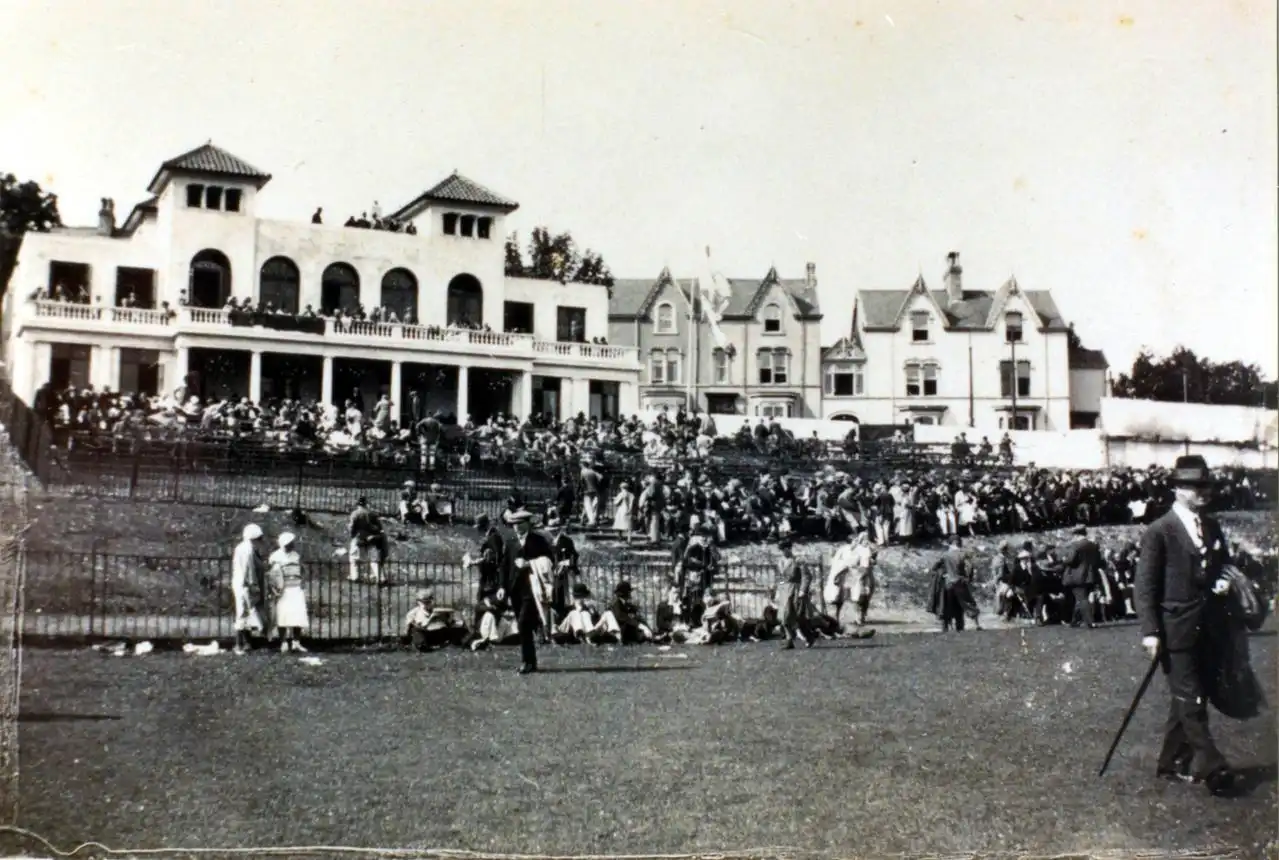
St.Helen`s: a first-class ground – Glamorgan Cricket Archives
St Helen’s, Swansea, the venue associated with Bakewell’s 257.
Performance snapshot
| Detail | Information |
|---|---|
| Batter | Fred Bakewell |
| Team | Northamptonshire |
| Opposition | Glamorgan |
| Venue | St Helen’s, Swansea |
| Season | 1933 |
| Score | 257 |
| Significance | Northamptonshire individual batting record at the time |
The contemporary report of the county matches described Bakewell’s double-century as one of the outstanding performances of an extraordinary scoring week.
Northamptonshire made 469 in the match, but Glamorgan won on the first innings. The result did not diminish the importance of Bakewell’s performance. Untitled+2
A historic 2,000-run season
Bakewell finished the 1933 season with:
- 1,925 runs in county matches.
- 2,110 runs in all matches.
- Seven centuries according to the later historical account.
- An average of approximately 46.
- Two consecutive double-centuries.
Wisden recorded him as the first Northamptonshire player to reach 2,000 runs in a season.
His 1933 performance was therefore important not only because of the individual innings but also because of the wider contribution he made to the county. Almanack+1
Fred Bakewell’s England Test Career
Bakewell represented England in six Test matches between 1931 and 1935.
Although his international career was short, his batting statistics were impressive. He scored 409 runs at an average of 45.44, with one century and three fifties.
He played against New Zealand, India, West Indies and South Africa.
Test debut against New Zealand in 1931
Bakewell made his Test debut against New Zealand at Lord’s on 27 June 1931.
The opening match did not produce the start he wanted. He scored nine in his first innings and 27 in his second, as England’s batting order experienced difficulties against the New Zealand bowling attack.
Ian Cromb dismissed him in both innings.
Despite the modest figures, the selectors retained interest in him. Cricket Web+2
The 40 against New Zealand at The Oval
Bakewell’s second Test came at The Oval in July 1931.
Opening alongside Herbert Sutcliffe, he scored 40 in England’s first innings.
His dismissal came through a run-out involving a difficult running decision. With Sutcliffe exposed, Bakewell chose to sacrifice his own wicket rather than risk losing the more experienced batter.
The partnership had added 84 runs before the incident.
England won the match by an innings and 26 runs. Bakewell was subsequently left out of the third Test as the selectors examined another opening option, Eddie Paynter. Almanack+2
The 1932 India Test
Bakewell did not play for England during 1932.
He scored more than 1,000 runs in the county season, but his overall form was below the standard of his best performances.
He was not selected for the inaugural England-India Test at Lord’s in 1932.
His international prospects improved significantly the following year when his Northamptonshire performances reached a new level. Cricket Web
The famous 107 against West Indies in 1933
His only Test century
Bakewell’s greatest international achievement came against West Indies at The Oval in August 1933.
He was selected for the third Test after initially missing out on the earlier matches. England needed a strong opening performance, particularly after the West Indies bowling attack had troubled the home batters at Old Trafford.
The West Indies were using fast, short-pitched bowling associated with the Bodyline controversy of that period.
Bakewell responded with an important innings of 107.
The Oval ground guide | The Cricketer
The Oval, London, where Bakewell scored his only Test century.
Match snapshot
| Detail | Information |
|---|---|
| Match | England vs West Indies, third Test |
| Dates | 12–15 August 1933 |
| Venue | The Oval, London |
| Bakewell’s score | 107 |
| England’s total | 312 |
| West Indies, first innings | 100 |
| West Indies, second innings | 195 |
| Result | England won by an innings and 17 runs |
Bakewell’s innings lasted 230 minutes. He was dismissed by Ben Sealey, caught by George Headley.
England eventually won comfortably, but Bakewell’s century was central to the first-innings total. He was the only batter among England’s top six to score more than 22.
The innings also demonstrated that his unusual technique could succeed against fast bowling, even in a match involving a particularly challenging bowling approach. i.imgci.com+3
The 1933–34 India and Ceylon tour
Following his century against West Indies, Bakewell earned selection for the MCC tour of India under Douglas Jardine.
The tour was a difficult experience initially.
He struggled with conditions and became the first tourist to be dismissed for a duck during the tour, according to the historical account.
His fortunes improved before the third and final Test. He scored 158 against Madras, which helped restore confidence in his batting.
He then scored 85 in the first innings of the final Test against India.
That performance represented a significant recovery from his earlier difficulties and demonstrated his ability to adjust after a poor start to a tour.
Important tour performances
- Early tour: struggled for consistency.
- Madras: scored 158 in a major recovery innings.
- Final Test against India: scored 85 in the first innings.
- Overall: 89 Test runs across his two innings against India, according to the career statistical breakdown. Cricket Web+1
Why Bakewell missed the 1934 Ashes
Bakewell’s performances during 1934 were less impressive than his record-breaking 1933 season.
The exhausting India tour was considered a possible reason for his slow start to the county season.
His batting average for Northamptonshire was approximately 32.30, and Jack Timms finished slightly ahead of him.
Consequently, Bakewell did not establish a convincing case for selection against Australia in the 1934 Ashes.
This was an important interruption in his international career. He had demonstrated his potential against West Indies and India, but he was unable to maintain the same level of performance throughout the following domestic season. Cricket Web
The 1935 South Africa Tests
Bakewell returned to stronger form during 1935.
His Northamptonshire batting average reached 42.32, and the county relied heavily on his contributions.
One particularly striking example came against Worcestershire. After scoring a duck in the first innings, he responded with 141 in the second innings.
Northamptonshire still lost the match by 30 runs because the rest of the batting order contributed very little.
Arthur Mitchell’s injury subsequently created an opportunity for Bakewell’s England recall.
He was selected for the final two Tests against South Africa, which became his last international appearances. Cricket Web+1
His final two Test performances
| Opposition | Innings | Runs |
|---|---|---|
| South Africa | First innings, fourth Test | 63 |
| South Africa | Second innings, fourth Test | 54 |
| South Africa | Final Test | 20 |
Bakewell scored 63 and 54 in the fourth Test, showing considerable consistency in difficult circumstances.
In the fifth Test, England’s match situation was complicated by South Africa’s substantial first-innings total. Bakewell scored 20 in England’s second innings.
He never played another Test. Cricket Web+2
Fred Bakewell’s Career Statistics
Bakewell’s statistical record reflects the quality of his batting and his additional contribution as a close fielder.
Test batting and bowling statistics
| Statistic | Record |
|---|---|
| Matches | 6 |
| Innings | 9 |
| Runs | 409 |
| Highest score | 107 |
| Average | 45.44 |
| Centuries | 1 |
| Fifties | 3 |
| Catches | 3 |
| Wickets | 0 |
First-class batting and bowling statistics
| Statistic | Record |
|---|---|
| Matches | 250 |
| Innings | 453 |
| Not out | 24 |
| Runs | 14,570 |
| Highest score | 257 |
| Average | 33.96 |
| Centuries | 31 |
| Fifties | 74 |
| Catches | 225 |
| Wickets | 22 |
| Best bowling | 2/17 |
| Bowling average | 57.77 |
CricketArchive+1
For a deeper breakdown of his international and county record, the relevant historical format records can be explored here:
Explore Fred Bakewell's complete Test stats
View Fred Bakewell's complete first-class stats
The general cricket statistics tool is also available:
Explore the complete cricket player statistics database
Fred Bakewell’s Playing Style and Fielding Ability
Bakewell was remembered for a batting technique that looked unusual even by the standards of his own generation.
His stance attracted criticism from traditionalists, but his actual batting results demonstrated that the method worked exceptionally well for him.
The unusual two-eyed batting stance
Bakewell stood with his right shoulder turned towards the bowler, almost facing the bowler full-on.
His grip was also unconventional, with his hands positioned unusually far apart on the bat handle.
The technique gave him a distinctive appearance at the crease, but it did not prevent him from playing a wide range of strokes.
Wisden’s 1934 profile highlighted several qualities:
- Excellent footwork when moving forward.
- Strong timing when driving.
- Powerful off-side strokes.
- Effective leg-side batting.
- Good awareness of the ball.
- An ability to remain difficult to dismiss.
He was particularly effective when driving through the off side.
Comparison with great batters of his period
The writer R. C. Robertson-Glasgow made a striking assessment of Bakewell’s ability.
He suggested that when Bakewell was in form, he could bat alongside Donald Bradman on reasonably equal terms.
Neville Cardus also made a favourable comparison between Bakewell and Victor Trumper.
These comparisons reflect the impression Bakewell made on contemporary cricket observers, rather than a statistical claim that he was equivalent to either player over a complete career. Cricket Web+2
Outstanding close fielder
Bakewell was not simply an attacking opening batter.
He was particularly effective in close-catching positions, especially at short leg.
His first-class record included 225 catches in 250 matches, an impressive return for a specialist batter.
His eight catches in the return match against Essex during his debut season illustrated his natural fielding ability.
The contemporary Wisden profile specifically praised his work close to the wicket. Almanack+1
Fred Bakewell’s Final 241 Not Out and the 1936 Accident
Final first-class innings
The most memorable innings of Bakewell’s final season came against Derbyshire at Chesterfield in 1936.
It was also the final first-class innings of his career.
Northamptonshire entered the match against the eventual County Championship winners as outsiders. Bakewell himself had not enjoyed a particularly consistent season.
In the first innings, he and opening partner Reggie Northway were dismissed for a combined total of just four runs. Northamptonshire eventually scored 144.
Derbyshire established a first-innings lead of 65, placing themselves in a strong position.
Bakewell then produced an extraordinary response.
The unbeaten 241 against Derbyshire
Bakewell scored 241 not out in Northamptonshire’s second innings, batting for approximately six hours.
His innings transformed the match and gave Northamptonshire an opportunity to put Derbyshire under serious pressure.
Final innings snapshot
| Detail | Information |
|---|---|
| Season | 1936 |
| Competition | County Championship |
| Team | Northamptonshire |
| Opposition | Derbyshire |
| Venue | Chesterfield |
| Score | 241 not out |
| Batting time | Approximately six hours |
| Derbyshire status | Eventual 1936 County Champions |
| Career significance | Bakewell’s final first-class innings |
Northamptonshire declared at 411 for six, with Bakewell’s innings providing the foundation.
Derbyshire subsequently lost five wickets for 54 runs, creating the possibility of a remarkable Northamptonshire victory. The lower order survived, however, and the match ended without the expected defeat for the champions.
Wisden regarded Bakewell’s innings as one of the finest of his career. Its most remarkable feature was the control he maintained throughout such a long innings. Cricket Web+2
The fatal journey with Reggie Northway
After the match, Bakewell travelled home with his Northamptonshire opening partner Reggie Northway.
Northway owned a two-seater sports car, and the pair left Chesterfield at approximately 11 pm.
Near Kibworth in Leicestershire, shortly before midnight, the vehicle crashed.
Northway was killed, while Bakewell suffered extremely serious injuries.
The historical account describes:
- A fractured skull.
- Facial paralysis.
- Severe damage to his right wrist and arm.
- Extensive injuries to his hands.
- A period during which he remained unconscious and critically ill.
Another Northamptonshire player, Jack Timms, was travelling ahead in a separate vehicle. When he noticed that Northway’s headlights had disappeared, he turned back and found the wreckage.
His return was credited with helping save Bakewell’s life.
Northway died in the accident, and the incident permanently changed Bakewell’s future. Cricket Web+2
Why did the accident end his cricket career?
Bakewell underwent major treatment, including surgery and bone grafts to his right arm.
Despite initial optimism, he never recovered sufficient movement and strength to return to professional cricket.
He could not fully bend the injured arm, and his batting career was effectively over.
Wisden’s 1937 account was more optimistic about his recovery than the subsequent evidence justified. Bakewell himself continued expressing hopes of returning for some time.
By the beginning of the 1939 season, however, he had abandoned hopes of a first-class comeback. Cricket Web+1
Fred Bakewell’s Life After Cricket
Bakewell’s story did not end with the accident. Unfortunately, the loss of his cricket career was followed by financial, personal and legal difficulties.
His later life was very different from the public recognition he had received during his Northamptonshire and England years.
Financial problems and family difficulties
After the accident, Bakewell struggled to establish a stable source of income.
In May 1938, he appeared before local magistrates in connection with financial provision for his wife and daughter.
The court ordered him to make weekly payments. At a subsequent hearing, he explained that he had not earned money since the previous appearance and that his accident compensation had been exhausted.
He also indicated that he expected to begin a part-time coaching position.
The marriage eventually ended in divorce in October 1939. The contemporary legal account, as subsequently examined by cricket historians, records adultery as the basis for the divorce decree.
These events should be understood as part of his documented personal history, not as an explanation for his cricketing ability. Cricket Web
Second marriage and later family life
Bakewell married again in 1940, according to the historical reconstruction of his life.
He had a daughter from his first marriage and a young daughter from his second marriage.
His son from the second marriage, John Bakewell, later provided valuable family information to Mick Pope, author of the 2025 biography Fred Bakewell: Among the Bright Colours.
The book’s research also benefited from the earlier interview conducted by cricket historian David Frith. Cricket Web+1
Legal and financial difficulties during the 1940s
Bakewell’s circumstances remained unstable.
In 1943, he appeared before magistrates after admitting theft-related offences involving cricketers’ wallets and diamond cutters.
The court imposed a fine and probation supervision.
The contemporary report also recorded that he had remarried and had a young daughter. The Chief Constable spoke in support of his character, acknowledging that Bakewell had positive qualities despite his offending.
A later historical reconstruction reports that Bakewell subsequently worked in the hospitality trade, including as a publican in Wisbech and Fowlmere.
These details come from historical reporting rather than an official cricket biography and should be treated as part of his documented personal history. Cricket Web
Another road accident in 1965
Bakewell experienced another serious road accident in 1965.
He was travelling as a passenger when the vehicle struck a lamp post following a journey connected with a court appearance.
He lost an eye in the accident.
His second wife also died during that year, adding another personal setback to an already difficult post-cricket life. Cricket Web+1
Final years and death
Cricket historian David Frith eventually located Bakewell in 1981, after he had spent many years largely outside public cricket discussion.
Frith interviewed him about his cricket career and personal experiences. Bakewell reportedly discussed his past with considerable frankness and without obvious bitterness about losing his playing career.
He died in Westbourne, Dorset, in January 1983, aged 74.
There is a minor discrepancy in published death dates: CricketArchive records 22 January 1983, while Cricbuzz and other databases give 23 January 1983. The precise date should be checked against the original death notice or civil record before being treated as definitively settled. CricketArchive+2
Fred Bakewell’s Awards, Recognition and Cricketing Honours
Bakewell’s most important formal recognition came during the peak of his county career.
1934 Wisden Cricketer of the Year
John Wisden’s Cricketers’ Almanack For 1936 |
Wisden Cricketer of the Year — 1934
Bakewell received the honour following his outstanding 1933 season, during which he scored more than 2,000 runs in all matches for Northamptonshire.Wisden+1
Northamptonshire Hall of Fame
Bakewell was included among the original inductees into the Northamptonshire County Cricket Club Hall of Fame.
The club’s recognition placed him alongside several important figures in its history, including George Thompson, Billy East, Nobby Clark, Vallance Jupp’s successors and later England players.
His inclusion reflects his importance to the county despite his relatively short career. Northamptonshire CCC+1
Other recognition
- Recognition in Wisden’s 1934 annual honours.
- Historical recognition as one of Northamptonshire’s outstanding interwar batters.
- A dedicated 2025 biography published by the Association of Cricket Statisticians and Historians.
Fred Bakewell’s Records and Career Milestones
| Record / achievement | Detail |
|---|---|
| First-class runs | 14,570 |
| First-class centuries | 31 |
| First-class highest score | 257 |
| Test runs | 409 |
| Test average | 45.44 |
| Test century | 107 against West Indies |
| 1933 season aggregate | 2,110 runs in all matches |
| Northamptonshire seasonal milestone | First player to score 2,000 runs in a season |
| Close-catching record | 225 first-class catches |
| Final first-class innings | 241 not out against Derbyshire |
| Wisden honour | 1934 Cricketer of the Year |
CricketArchive+2
Fred Bakewell’s Career Timeline
| Year | Age | Career development |
|---|---|---|
| 1908 | 0 | Born in Walsall, Staffordshire |
| c.1924 | 15 | Entered an approved school in Oxford |
| 1928 | 19 | Made his Northamptonshire county debut |
| 1929 | 20 | Established himself as a regular county batter |
| 1930 | 21 | Scored 204 against Somerset |
| 1931 | 22 | Made his England Test debut against New Zealand |
| 1932 | 23 | Played no Test cricket |
| 1933 | 24 | Scored 246 and 257 in consecutive county matches; made 107 against West Indies |
| 1934 | 25 | Named a Wisden Cricketer of the Year |
| 1934 | 25 | Scored 85 against India in the final Test of the tour |
| 1935 | 26 | Returned to England’s Test team against South Africa |
| 1936 | 27 | Scored 241 not out against Derbyshire before the fatal accident |
| 1938 | 29 | Faced financial and family-related court proceedings |
| 1943 | 34 | Appeared before magistrates in theft-related cases |
| 1965 | 56 | Lost an eye in another road accident |
| 1981 | 72 | Interviewed by cricket historian David Frith |
| 1983 | 74 | Died in Dorset |
Almanack+3
Fred Bakewell’s Family, Net Worth and Personal Details
Several searches associated with Bakewell concern his family, personal life and finances. Historical evidence provides some answers, but not every modern biographical field can be established.
What was Fred Bakewell’s net worth?
No dependable historical net-worth figure has been established.
His accident compensation, financial difficulties and employment history are discussed in later biographical research, but these do not provide a reliable calculation of his total assets or wealth.
Who were Fred Bakewell’s parents?
His father is identified in a biographical account as a leather maker. A dependable full name for his mother has not been established in the sources reviewed.
Did Fred Bakewell have children?
Yes. Historical accounts identify a daughter from his first marriage and children from his second marriage. His son John Bakewell later helped author Mick Pope with biographical research.
Was Fred Bakewell a footballer?
CricketArchive records football as another sport in which he participated. He played as an inside-forward for Northampton Nomads and other teams. CricketArchive+2
Fred Bakewell’s Biography: A Final Perspective
Fred Bakewell’s career remains an important part of Northamptonshire’s cricket history. His 14,570 first-class runs, 31 centuries and Test average of 45.44 demonstrate the standard he achieved in a relatively short period.
His 1933 season showed how effective his unusual batting technique could be, while his unbeaten 241 against Derbyshire in 1936 remains a remarkable final contribution to first-class cricket.
The accident that ended his career prevented him from developing the international record his ability appeared to promise. His later life was complicated, but the cricketing achievements remain substantial.
Bakewell is remembered not simply for what he accomplished, but also for the extraordinary career that ended at just 27.
Frequently Asked Questions About Fred Bakewell
1. What was Fred Bakewell’s full name?
His full name was Alfred Harry Bakewell. He was commonly known as Fred Bakewell.
2. When and where was Fred Bakewell born?
He was born on 2 November 1908 in Walsall, Staffordshire, England.
3. Which county did Fred Bakewell play for?
He represented Northamptonshire throughout his first-class career, from 1928 to 1936.
4. How many Test matches did Fred Bakewell play?
He played six Tests for England between 1931 and 1935.
5. What was Fred Bakewell’s highest Test score?
His highest Test score was 107 against West Indies at The Oval in August 1933.
6. How many first-class runs did Fred Bakewell score?
He scored 14,570 runs in 250 first-class matches, averaging 33.96.
7. What was Fred Bakewell’s highest first-class score?
His highest first-class score was 257 for Northamptonshire against Glamorgan in 1933.
8. Why did Fred Bakewell retire from cricket?
He did not retire through a conventional decision. A serious road accident in 1936 severely damaged his right arm and ended his ability to play professional cricket.
9. Why was Fred Bakewell named a Wisden Cricketer of the Year?
He received the 1934 recognition after scoring 2,110 runs in all matches during Northamptonshire’s record-breaking 1933 season.
10. How did Fred Bakewell die?
He died in January 1983 in Westbourne, Dorset. CricketArchive and Cricbuzz differ by one day in their recorded death dates.
11. Did Fred Bakewell play limited-overs cricket?
No. His career took place before the establishment of modern List A and Twenty20 cricket.
12. Was Fred Bakewell inducted into the Northamptonshire Hall of Fame?
Yes. He was among the original inductees into Northamptonshire’s Hall of Fame. CricketArchive+3
Conclusion
Fred Bakewell remains one of the most intriguing English cricketers of the 1930s, remembered for his unconventional batting style, remarkable stroke-making ability and outstanding performances for Northamptonshire and England. Despite playing in a struggling county side, he consistently demonstrated his individual quality and became one of the most exciting batsmen of his generation. His six Test appearances produced 409 runs at an impressive average of 45.44, including one century and three half-centuries. His unbeaten 241 against Derbyshire in 1936 further demonstrated his extraordinary batting talent and determination.
Unfortunately, Bakewell’s promising career came to a tragic end following a serious car accident in 1936, which permanently damaged his right arm and prevented him from returning to professional cricket. At just 27 years old, he lost the opportunity to achieve even greater success on the international stage. Nevertheless, his achievements, including being named a Wisden Cricketer of the Year in 1934, secured his place in cricket history. Fred Bakewell’s story is not simply about statistics and records; it is also about exceptional talent, individuality and a career interrupted by unfortunate circumstances. His contribution to English cricket deserves to be remembered by future generations.
Sources: CricketArchive+2