
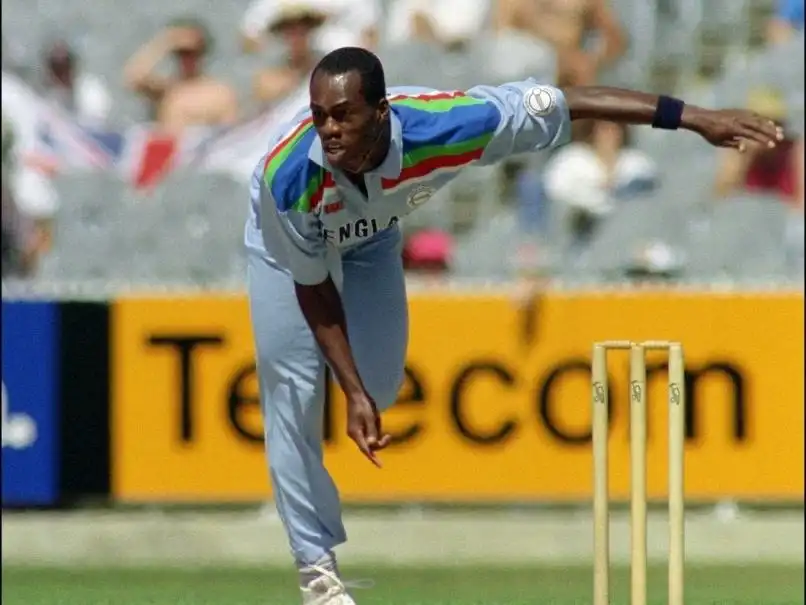
Player: Clairmonte Christopher Lewis (Chris Lewis)
Country: England
Born: 14 February 1968
Birthplace: Georgetown, Guyana
Role: All-rounder
Batting: Right-handed
Bowling: Right-arm fast-medium
International career: 1990–1998 (Tests: 1990–1996)
Chris Lewis was an England all-rounder who represented his country in 32 Test matches and 53 One Day Internationals. Born in Guyana, he moved to England with his family at the age of 10 and developed into a talented fast-medium bowler and aggressive lower-order batter. His career included the 1992 Cricket World Cup final, a memorable Test century against India and successful county cricket with Leicestershire and Nottinghamshire. His later life also attracted considerable attention following his 2009 conviction for drug smuggling and his subsequent efforts to rebuild his life. BBC Sport+3
Chris Lewis Career Stats
| Format | Career | Matches | Innings | Runs | HS | Bat Avg | 50s | 100s | Wickets | BBI | Bowl Avg |
|---|---|---|---|---|---|---|---|---|---|---|---|
| TESTRecorded matches only — career source held | 1990–1996 | 31 | 56 | 1,064 | 117 | 23.13 | 4 | 1 | 90 | — | 37.56 |
| ODIRecorded matches only — career source held | 1990–1998 | 22 | 21 | 155 | 29 | 15.50 | 0 | 0 | 31 | — | 24.87 |
This compact table is rendered directly from the shared per-format source selection; recorded-only rows are explicitly labelled. Detailed opponent, venue, year and dismissal analysis remains on the full stats page.

Chris Lewis
/cricket-player/chris-lewis/Each format uses one source consistently. Recorded-only figures are labelled separately.
Recorded matches only — career source held
Recorded matches only — career source held
Part 1 — Complete Cricket Biography
Chris Lewis Quick Facts
| Profile | Details |
|---|---|
| Full name | Clairmonte Christopher Lewis |
| Nickname | Carl |
| Date of birth | 14 February 1968 |
| Age | 58 (November 2026) |
| Birthplace | Georgetown, Guyana |
| Nationality | English |
| Height | Reported as 6 ft 2 in; independent primary confirmation not located |
| Batting style | Right-handed |
| Bowling style | Right-arm fast-medium |
| Playing role | Bowling all-rounder |
| Test debut | 5 July 1990 vs New Zealand |
| ODI debut | 14 February 1990 vs West Indies |
| Last Test | August 1996 |
| Last ODI | 23 May 1998 |
| International matches | 85 |
| International runs | 1,479 |
| International wickets | 159 |
| Highest Test score | 117 |
| Best Test bowling | 6/111 |
| Best ODI bowling | 4/30 |
| Major county teams | Leicestershire, Nottinghamshire, Surrey |
| Major award | 1992 Cricket Society Wetherall Award |
| Autobiography | Crazy: My Road to Redemption |
CricketArchive+4
Early Life, Childhood and Family Background
Birth in Guyana and move to England
Chris Lewis was born on 14 February 1968 in Georgetown, Guyana. His full name is Clairmonte Christopher Lewis. He spent his early childhood in Guyana before moving to England with his parents when he was approximately 10 years old.
His father was a Baptist preacher. The family eventually settled in North London, where Lewis experienced a different environment and greater opportunities to concentrate on cricket.
In a 1996 interview with The Independent, Lewis reflected on the contrast between his childhood in Guyana and his upbringing in England. He explained that children in Guyana sometimes had to work to help support their families, whereas moving to England gave him more freedom to enjoy childhood and play cricket.
He also acknowledged that the move had played an important part in his development as a professional cricketer. The Independent+1
How Chris Lewis developed an interest in cricket
Cricket was already part of everyday life in Guyana when Lewis was growing up. He remembered seeing games regularly and playing alongside other children.
His move to England provided an opportunity to develop that interest into a professional career. He grew up in North London and attended school alongside future England international Phil DeFreitas.
The two players subsequently began their professional careers with Leicestershire.
Important early-life details:
- Born and raised initially in Georgetown, Guyana.
- Moved to England at around 10 years of age.
- Grew up in North London.
- His father was a Baptist preacher.
- Met future England teammate Phil DeFreitas at school.
- Began his professional county career with Leicestershire in 1987.
The Independent+2
Chris Lewis’s parents and siblings
Lewis’s father’s occupation as a Baptist preacher is documented in contemporary journalism. However, reliable public sources reviewed do not establish his father’s name, his mother’s name or a complete list of siblings.
His autobiography also discusses his childhood and move to England, but specific family relationships should not be added without stronger confirmation.
Education and school
Lewis attended school in North London, where he met Phil DeFreitas. Although their school connection is documented, a sufficiently reliable source confirming the institution’s exact name was not established.
Chris Lewis’s Domestic Cricket Career
Lewis began his professional county career with Leicestershire in 1987. His combination of right-arm fast-medium bowling, middle-order batting and athletic fielding made him an attractive all-round prospect.
His domestic career involved three major English counties: Leicestershire, Nottinghamshire and Surrey.
Leicestershire: Professional breakthrough
Lewis made his Leicestershire debut in June 1987. He developed through the county’s professional structure and earned recognition at a young age.
By the end of his first spell, he had established himself as an England international and was attracting interest from other counties.
His initial Leicestershire association ran from 1987 to 1991. He subsequently returned for another spell between 1998 and 2000. trentbridge.co.uk+1
Nottinghamshire: The 247 and 301-run partnership
Lewis joined Nottinghamshire ahead of the 1992 season, in a major signing for the county.
His start at Trent Bridge was particularly impressive.
In only his second County Championship appearance, he scored an unbeaten 134 and also took five wickets in the match. Later in the season, he recorded his best bowling analysis for Nottinghamshire, taking 6/90 against Surrey.
His 1993 season included another remarkable achievement: a score of 247, which was Nottinghamshire’s highest individual score since the Second World War at that time.
He also shared a county-record seventh-wicket partnership of 301 runs with Bruce French.
Nottinghamshire career highlights
2,256
First-Class runs
127
First-Class wickets
247
Highest county score
301
Record seventh-wicket stand
Figures from his 37 First-Class appearances for Nottinghamshire.
Lewis also topped Nottinghamshire’s First-Class batting and bowling averages in 1994.
However, his time at the county became difficult. A hip injury early in 1995 affected his availability, and Nottinghamshire released him partway through the fourth year of his six-year contract.
His departure was a significant interruption to a promising domestic career. trentbridge.co.uk+1
Surrey and return to Leicestershire
Lewis joined Surrey in 1996 and remained there for two seasons in First-Class cricket.
He subsequently returned to Leicestershire, where he continued playing until 2000.
His full-time professional First-Class career effectively ended in 2000, although he later attempted a limited comeback with Surrey in 2008.CricketArchive+2
Chris Lewis International Cricket Career
Lewis represented England between 1990 and 1998. He played 32 Tests and 53 ODIs, contributing with both bat and ball.
His international career included some memorable performances, although he struggled to maintain the consistency expected of a leading English all-rounder.
Test cricket debut and career
Lewis made his Test debut against New Zealand at Edgbaston on 5 July 1990.
He went on to play 32 Test matches, scoring 1,105 runs and taking 93 wickets.
His Test batting average was 23.02, while his bowling average was 37.52.
Test career summary
| Statistic | Record |
|---|---|
| Matches | 32 |
| Runs | 1,105 |
| Batting average | 23.02 |
| Highest score | 117 |
| Centuries | 1 |
| Half-centuries | 4 |
| Wickets | 93 |
| Bowling average | 37.52 |
| Best bowling | 6/111 |
| Five-wicket hauls | 3 |
Crickrida+2
For his complete Test batting and bowling records, use:
Explore Chris Lewis's complete Test stats
The memorable 117 against India in Chennai
One of Lewis’s most memorable batting performances came against India in the second Test at Madras (now Chennai) in February 1993.
India had scored 560/6 declared in their first innings. England were subsequently dismissed for 286, forcing them to follow on.
Lewis then produced a superb innings of 117 from 140 deliveries in England’s second innings.
Match snapshot
| Detail | Information |
|---|---|
| Match | India vs England, second Test |
| Date | 11–15 February 1993 |
| Venue | MA Chidambaram Stadium, Madras |
| Lewis’s score | 117 |
| Balls faced | 140 |
| Fours | 15 |
| Sixes | 2 |
| Bowling opposition | Anil Kumble took his wicket |
| Result | India won by an innings and 22 runs |
Lewis’s innings included a determined effort despite England’s difficult position. He was eventually dismissed by Kumble, caught and bowled.
The performance remains a defining highlight of his international batting career. Cricinfo+1
ODI career with England
Lewis made his ODI debut against West Indies at Port of Spain on 14 February 1990.
He played 53 One Day Internationals between 1990 and 1998.
His ODI career produced 374 runs and 66 wickets. His best bowling performance was 4/30.
| ODI statistic | Record |
|---|---|
| Matches | 53 |
| Runs | 374 |
| Batting average | 14.38 |
| Highest score | 33 |
| Batting strike rate | 81.48 |
| Wickets | 66 |
| Bowling average | 29.42 |
| Economy rate | 4.43 |
| Best bowling | 4/30 |
England Cricket+1
His ODI contribution was primarily through bowling and lower-order batting rather than consistent run-scoring.
See Chris Lewis's complete ODI stats
1992 Cricket World Cup
One of the biggest occasions of Lewis’s international career was the 1992 Cricket World Cup in Australia and New Zealand.
He represented England in the tournament and was part of the side that reached the final against Pakistan at the Melbourne Cricket Ground on 25 March 1992.
England lost the final by 22 runs.
Lewis scored zero from one delivery in the final and bowled 10 overs for 52 runs without taking a wicket.
Although he did not produce a major individual performance in the final, reaching the World Cup final was an important milestone in his career.
Pakistan scored 249/6 before England were dismissed for 227. Wasim Akram was named Player of the Match. PCB+1
Chris Lewis’s Career Statistics Across Formats
His overall professional record demonstrates his value as a genuine multi-skill cricketer.
| Format | Matches | Runs | Wickets |
|---|---|---|---|
| Test | 32 | 1,105 | 93 |
| ODI | 53 | 374 | 66 |
| First-Class | 189 | 7,406 | 543 |
| List A | 266 | 3,959 | 312 |
International figures are supported by cricket statistical records. Domestic totals are compiled from published career-statistics databases. Crickrida+2
For his complete domestic and international statistics:
View Chris Lewis's complete first-class statsExplore Chris Lewis's complete List A recordView Chris Lewis's domestic and franchise T20 stats
Lewis’s complete career record can also be explored through the [general cricket statistics tool] using the site’s general stats integration:
Explore the complete cricket player statistics database
Chris Lewis’s Playing Style and All-Round Ability
Lewis was a right-handed batter and right-arm fast-medium bowler.
His main strengths included:
- Fast-medium bowling.
- Lower-middle-order batting.
- Powerful hitting when attacking.
- Athletic fielding.
- The ability to contribute in several departments.
He was often viewed as a potential successor to Ian Botham, a comparison that created substantial expectations.
However, injuries, inconsistent performances and off-field controversies affected his ability to fulfil that potential.
His career is an example of the difference between possessing considerable natural ability and consistently converting it into international success. The Independent+2
Awards and Recognition
One notable achievement was the 1992 Cricket Society Wetherall Award, presented to the leading all-rounder in English First-Class cricket.
His Nottinghamshire career also produced outstanding individual and partnership milestones.
Notable recognition:
- 1992 Cricket Society Wetherall Award.
- Nottinghamshire’s highest individual score since the Second World War at the time, 247.
- Nottinghamshire seventh-wicket partnership record of 301 with Bruce French.
CricketArchive+1
Chris Lewis and the 1999 Match-Fixing Controversy
Lewis’s international career became increasingly complicated during the late 1990s.
In 1999, he reported that a bookmaker had approached him about fixing cricket matches. Lewis said he refused the approach and reported the conversation to the England and Wales Cricket Board and the police.
He also said that three England players had been named to him by the bookmaker. Importantly, this was information he reported hearing, not proof that those players had committed wrongdoing.
The controversy affected his relationship with sections of the cricket establishment and public opinion. Lewis later described feeling isolated and unfairly treated.
His account of the events was discussed in interviews with The Guardian and in his autobiography.
It is essential to distinguish Lewis’s reported allegations from established findings. The names he said were mentioned should not be treated as evidence of guilt. The Guardian+3
Chris Lewis’s Drug-Smuggling Conviction and Prison Sentence
The most serious chapter of Lewis’s life began in December 2008.
On 8 December 2008, he was arrested at Gatwick Airport after returning from St Lucia. Authorities discovered liquid cocaine concealed in fruit juice tins in his cricket luggage.
The drugs were reported to have a street value of approximately £140,000.
In May 2009, Lewis and former basketball player Chad Kirnon were convicted of drug smuggling and sentenced to 13 years in prison.
Lewis later acknowledged that financial concerns and poor decisions had contributed to his actions.
This episode brought an abrupt end to his attempt to rebuild his professional cricket career and became a defining part of his public life. The Guardian+2
Release from prison in 2015
Lewis was released in June 2015 after serving approximately six and a half years.
Following his release, he spoke openly about his mistakes and the difficulties of adjusting to life outside prison.
In interviews, he described the psychological challenges of imprisonment and his determination to rebuild his life.
He also expressed regret for his decisions and acknowledged their consequences. BBC Sport+1
Chris Lewis After Prison: Coaching, Speaking and Helping Young Cricketers
Following his release, Lewis began working with the Professional Cricketers’ Association (PCA).
His work focused on helping younger professional cricketers understand the risks associated with poor financial planning, career transitions and irresponsible decisions.
In 2016, he planned to visit all 18 first-class counties to share his experiences with players.
His message was particularly relevant to professional athletes whose sporting careers can end earlier than expected.
The PCA initiative gave Lewis an opportunity to use his own experience to educate others. BBC Sport+1
The Long Walk Back
Lewis’s experiences also inspired The Long Walk Back, a theatrical production about his imprisonment and the psychological journey of rebuilding his life.
The play was written by Dougie Blaxland and received attention as an account of the emotional consequences of imprisonment. trentbridge.co.uk+1
Chris Lewis’s Autobiography: Crazy: My Road to Redemption
Lewis published his autobiography, Crazy: My Road to Redemption, in 2017.
Crazy: My Road to Redemption
- Author: Chris Lewis
- Publisher: The History Press
- Publication date: 1 September 2017
- ISBN: 9780750983259
- Length: 208 pages
The book covers his childhood in Guyana, his move to England, his cricketing career, the match-fixing controversy, his conviction and his efforts to rebuild his life.
It offers his personal account of the events that shaped his journey. The History Press+1
Chris Lewis Career Timeline
| Year | Career development |
|---|---|
| 1968 | Born in Georgetown, Guyana |
| Around 1978 | Moved to England with his family |
| 1987 | Made professional county debut for Leicestershire |
| 1990 | England ODI and Test debuts |
| 1992 | Joined Nottinghamshire; appeared in World Cup final; won Wetherall Award |
| 1993 | Scored 247 for Nottinghamshire and 117 against India |
| 1994 | Topped Nottinghamshire’s First-Class batting and bowling averages |
| 1995 | Hip injury disrupted his Nottinghamshire career |
| 1996 | Joined Surrey and played his final Test |
| 1998 | Played his final ODI |
| 2000 | End of full-time First-Class career |
| 2008 | Attempted a comeback with Surrey; arrested at Gatwick |
| 2009 | Sentenced to 13 years in prison |
| 2015 | Released from prison |
| 2016 | Worked with the PCA on player education |
| 2017 | Published his autobiography |
| 2019 | The Long Walk Back brought his story to the stage |
trentbridge.co.uk+4
Chris Lewis’s Current Life and Career Status
Former England international
As of November 2026, Lewis is a former professional international cricketer. His last Test was in 1996, his last ODI was in 1998 and his First-Class career ended in 2000.
His later public activities have included cricket-related speaking, coaching and educational work. However, a current formal coaching appointment or active playing contract could not be independently confirmed.
His public story is now closely associated with both his England cricket career and his efforts to help other athletes learn from his experiences.
Chris Lewis’s Personal Life, Relationships and Family
Lewis has spoken publicly about his childhood, parents and experiences growing up between Guyana and England.
However, reliable evidence reviewed for this biography does not establish sufficient details about his wife, girlfriend, children or siblings.
It would be misleading to publish names or relationship claims based on unsupported biography websites.
Similarly, no dependable public financial disclosure or independently verified net-worth estimate was established.
Chris Lewis vs Other England All-Rounders
Lewis played during an era that included several prominent England all-rounders, including Ian Botham and Phil DeFreitas.
His career can be understood through comparisons with players who combined batting and bowling responsibilities.
Start typing Player B, choose a result, then compare instantly from cached career summaries. Compare Chris Lewis
Player A is locked to this biography
The comparison feature should allow readers to select another cricketer and compare overlapping formats.
Frequently Asked Questions About Chris Lewis
1. Who is Chris Lewis?
Chris Lewis is a former England international cricket all-rounder who played 32 Tests and 53 ODIs between 1990 and 1998.
2. How old is Chris Lewis?
He was born on 14 February 1968 and is 58 years old in November 2026.
3. Where was Chris Lewis born?
He was born in Georgetown, Guyana, and moved to England with his family when he was approximately 10.
4. What was Chris Lewis’s highest Test score?
His highest Test score was 117, made against India in Chennai in February 1993.
5. How many wickets did Chris Lewis take for England?
He took 93 Test wickets and 66 ODI wickets, giving him 159 international wickets.
6. Did Chris Lewis play in the 1992 World Cup final?
Yes. He represented England in the final against Pakistan at the Melbourne Cricket Ground. England lost by 22 runs.
7. Which counties did Chris Lewis play for?
He played First-Class cricket for Leicestershire, Nottinghamshire and Surrey.
8. Why did Chris Lewis go to prison?
He was convicted in 2009 for attempting to smuggle liquid cocaine into Britain from St Lucia and received a 13-year sentence.
9. When was Chris Lewis released from prison?
He was released in June 2015 after serving approximately six and a half years.
10. Did Chris Lewis write a book?
Yes. His autobiography is called Crazy: My Road to Redemption, published in 2017.
11. What was Chris Lewis’s bowling style?
He bowled right-arm fast-medium and was also a right-handed middle-order batter.
12. What is Chris Lewis’s net worth?
No dependable, independently verified public net-worth figure has been established.
conclusion
Chris Lewis remains an interesting figure in English cricket history. His natural all-round ability, impressive county performances, 1992 World Cup appearance and memorable Test century against India demonstrated his potential.
His career also illustrates how injuries, inconsistency and personal decisions can change the direction of a professional sporting life.
His subsequent work with the PCA, autobiography and public speaking have allowed him to discuss those experiences and encourage younger cricketers to make better decisions.