
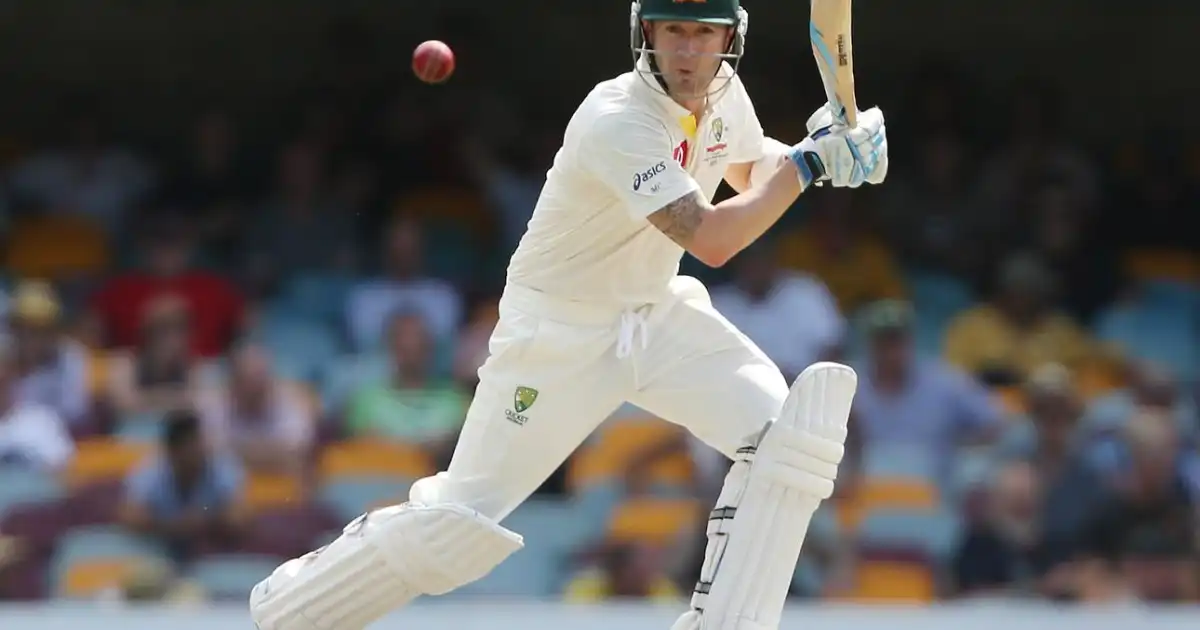
Michael Clarke is a former Australian international cricketer and captain remembered for his elegant right-handed batting, exceptional Test-match run-scoring, and leadership of Australia during one of the defining periods of modern Ashes cricket. Born on 2 April 1981 in Liverpool, New South Wales, Clarke progressed from junior cricket in Sydney’s west to becoming one of Australia’s leading batters. His career included a century on Test debut against India in 2004, an extraordinary unbeaten 329 against the same opposition in 2012, four Allan Border Medals, and captaincy of Australia’s 2015 ICC Cricket World Cup-winning team. He retired from international cricket in 2015 after 115 Tests, 245 ODIs and 34 T20 internationals.
Michael Clarke Career Stats
| Format | Career | Matches | Innings | Runs | HS | Bat Avg | 50s | 100s | Wickets | BBI | Bowl Avg |
|---|---|---|---|---|---|---|---|---|---|---|---|
| TESTReconciled source snapshot | 2004–2015 | 115 | 198 | 8,643 | 329* | 49.10 | 27 | 28 | 31 | 6/9 | 38.19 |
| ODIReconciled source snapshot | 2003–2015 | 245 | 223 | 7,981 | 130 | 44.58 | 58 | 8 | 57 | 5/35 | 37.64 |
| T20ICareer source | 2005–2010 | 34 | — | 488 | 67 | 21.21 | 1 | 0 | 6 | 1/2 | 37.50 |
| T20Recorded matches only | 2012–2012 | 6 | 6 | 98 | 41 | 16.33 | 0 | 0 | 2 | — | 33.50 |
This compact table is rendered directly from the shared per-format source selection; recorded-only rows are explicitly labelled. Detailed opponent, venue, year and dismissal analysis remains on the full stats page.
Michael Clarke
/cricket-player/michael-clarke/Each format uses one source consistently. Recorded-only figures are labelled separately.
Reconciled source snapshot
Reconciled source snapshot
Career source
Recorded matches only
Michael Clarke Quick Facts
| Profile | Details |
|---|---|
| Full name | Michael John Clarke |
| Common name | Michael Clarke |
| Date of birth | 2 April 1981 |
| Age | 45 as of 19 October 2026 |
| Birthplace | Liverpool, New South Wales, Australia |
| Nationality | Australian |
| Profession | Former international cricketer, commentator and media personality |
| Batting style | Right-handed |
| Bowling style | Slow left-arm orthodox |
| Primary role | Top-order/middle-order batter |
| International team | Australia |
| First international appearance | ODI debut in 2003 |
| Test debut | October 2004, against India |
| Test career | 2004–2015 |
| ODI career | 2003–2015 |
| T20I career | 2005–2012 |
| Highest Test score | 329 |
| Highest ODI score | 130 |
| Highest T20I score | 67 |
| Test matches | 115 |
| ODI matches | 245 |
| T20I matches | 34 |
| Major leadership achievement | Captained Australia to the 2015 Cricket World Cup |
| Major individual honour | 2013 ICC Cricketer of the Year |
| Australian domestic team | New South Wales |
| IPL team | Pune Warriors India |
| International retirement | August 2015 |
Michael Clarke’s Early Life, Childhood and Family Background
Michael John Clarke was born on 2 April 1981 in Liverpool, a suburb in the western part of Sydney, New South Wales. He grew up in a family where cricket was an important part of everyday life, and his early exposure to the sport helped establish the foundations of his professional career.
Clarke’s childhood is particularly relevant to understanding his development because his father’s involvement in cricket gave him access to facilities and playing opportunities from a young age. Rather than discovering the sport only through formal school competitions, Clarke was able to spend considerable time around cricket and practise regularly.
Michael Clarke’s parents and siblings
Clarke’s parents are Les Clarke and Debbie Clarke. His father played an important role in his early exposure to cricket.
Verified family details
- Father: Les Clarke, who had a strong connection with cricket and helped provide Michael with early access to the game.
- Mother: Debbie Clarke.
- Siblings: Biographical reporting describes Michael as the second child and only son in his family.
- Childhood location: Liverpool, in Sydney’s western suburbs.
A particularly important detail is that Michael’s father became involved in running an indoor cricket centre. The facility gave the young Clarke a place to practise and develop his skills, making cricket part of his normal routine rather than an occasional activity.
Wisden’s biographical feature on Clarke describes how he spent time at the centre from childhood, observing the game and practising batting. This background helps explain the unusually early start to his cricket development.
Almanack
+1
How Michael Clarke started playing cricket
Clarke has recalled wanting to follow his father’s example from around the age of six. Cricket and rugby league were both interests during his childhood, but cricket became the sport that ultimately shaped his professional life.
His early development included:
- Regular practice at his father’s indoor cricket facility.
- Participation in junior cricket in Sydney.
- Progression into grade cricket at a young age.
- Exposure to competitive senior cricket before turning 18.
One notable aspect of Clarke’s development was that he learned to bat right-handed despite being naturally left-handed in other activities. This became part of his distinctive cricketing profile.
Michael Clarke’s early back problem
Clarke’s cricket career was affected by a back condition from a relatively young age. According to biographical accounts, medical scans when he was around 17 revealed three degenerative discs in his lower back.
The condition required attention to fitness and core strength. It also became a recurring consideration throughout his career, when back problems sometimes affected his availability and preparation.
This early difficulty is important context for a player who later produced long, physically demanding Test innings and captained Australia through multiple international campaigns. His career was not free of physical setbacks, even during his most productive years.
Almanack
+1
Michael Clarke’s Education, Junior Cricket and First-Class Breakthrough
Clarke’s development took place in Sydney’s junior and grade-cricket system. His school years were connected with his growing interest in competitive cricket, while club cricket provided the pathway towards senior selection.
School and junior development
Clarke attended Marsden Road Public School in Liverpool, New South Wales. His early cricket development was also connected with Western Suburbs District Cricket Club, where he progressed through the local cricket system.
| Development stage | Detail |
|---|---|
| Early schooling | Marsden Road Public School |
| Early cricket environment | Liverpool, western Sydney |
| Junior club connection | Western Suburbs District Cricket Club |
| Family cricket influence | Les Clarke and the family’s indoor cricket facility |
| Senior breakthrough | New South Wales cricket |
| First-Class debut | December 1999 |
These early experiences exposed Clarke to competitive cricket while he was still a teenager. His progression into New South Wales cricket was especially significant because it placed him in a state system that regularly supplied players to the Australian national team.
First-Class debut at 17
Clarke made his First-Class debut for New South Wales in December 1999, aged 17, in a match against the touring Indian team at the Sydney Cricket Ground.
The debut gave him experience against international opposition before he had established himself as a senior Australian player. It also marked the beginning of a professional career that would eventually include more than a decade of international cricket.
His development pathway illustrates how early exposure to senior domestic cricket can accelerate a player’s preparation for international selection. Clarke’s subsequent performances in domestic and age-group cricket helped strengthen his claim for a national opportunity.
Michael Clarke’s International Debut and Rise in Australian Cricket
Clarke entered international cricket in 2003 and quickly established himself as a batter capable of performing against high-quality opposition. His breakthrough was unusually emphatic: he scored a century on his Test debut against India in 2004.
ODI debut in 2003
Clarke made his One Day International debut against England in January 2003. His early ODI career allowed Australia to assess his ability in the middle order, particularly his capacity to rotate the strike and accelerate when opportunities arose.
Australia had considerable batting depth during this period, so Clarke needed to establish himself among experienced international players. His performances helped him become part of the team’s longer-term plans.
Test debut against India in 2004
Clarke made his Test debut in Bangalore in October 2004. He scored 151 in the first innings, immediately announcing himself as a batter capable of handling international pressure.
Test debut snapshot

Australia vs India
- Competition: Test cricket
- Venue: M. Chinnaswamy Stadium, Bangalore
- Year: 2004
- Clarke’s score: 151
- Significance: A century on Test debut
The innings gave Australia an immediate return on its decision to select the young batter. Instead of needing a long adjustment period, Clarke demonstrated that he could score heavily at the highest level.
He also showed that he was more than a specialist white-ball prospect. His temperament and ability to construct a substantial innings became central features of his Test career.
ICC
+1
A remarkable bowling performance in India
During Australia’s 2004 tour of India, Clarke also produced an unusual achievement for a batter. In an ODI against India in Mumbai, he took six wickets for nine runs.
The performance demonstrated his value as a part-time slow left-arm orthodox bowler. Although batting was his primary skill, Clarke could contribute with the ball and occasionally influence matches through an unexpected bowling spell.
Cricket Australia’s retrospective on his career highlighted this spell as one of his most striking statistical achievements.
Michael Clarke’s Career Timeline
| Year | Team or level | Major development |
|---|---|---|
| 1981 | Liverpool, New South Wales | Born on 2 April |
| Childhood | Junior cricket | Developed his game around his father’s indoor cricket centre |
| 1999 | New South Wales | First-Class debut at 17 |
| 2000 | Australia Under-19s | Represented Australia at the Under-19 World Cup |
| 2003 | Australia | ODI debut against England |
| 2004 | Australia | Test debut; scored 151 against India |
| 2005 | Australia | Won his first Allan Border Medal |
| 2006 | Australia | Part of the Champions Trophy-winning team |
| 2007 | Australia | Won the ODI World Cup; scored heavily during the tournament |
| 2008 | Australia | Became a senior leadership figure and vice-captain |
| 2009 | Australia | Joint Allan Border Medal winner with Ricky Ponting |
| 2011 | Australia | Became Australia’s Test and ODI captain |
| 2012 | Australia | Scored an unbeaten 329 against India |
| 2013 | Australia | Won the ICC Cricketer of the Year and Test Cricketer of the Year awards |
| 2013–14 | Australia | Captained Australia to a 5–0 home Ashes victory |
| 2015 | Australia | Captained Australia to the Cricket World Cup title |
| August 2015 | Australia | Retired from international cricket |
Michael Clarke’s Domestic Cricket Career with New South Wales
New South Wales was the principal domestic team in Clarke’s development. His early First-Class debut gave him a route into senior cricket, while continued involvement in Australian domestic competitions helped him maintain match readiness between international assignments.
Sheffield Shield and domestic development
Clarke’s domestic cricket experience was important for three reasons:
- It exposed him to the longer format at a young age.
- It gave him experience against senior professional bowlers before and during his international career.
- It provided a competitive environment in which he could continue refining his batting and part-time bowling.
He remained associated with New South Wales during his professional career, alongside his international commitments. Domestic statistics should be read separately from his Australia figures because First-Class and List A cricket include matches outside the international game.
For a format-by-format statistical breakdown, use the player’s First-Class and List A records:
View Michael Clarke's complete first-class stats
Explore Michael Clarke's complete List A record
Domestic cricket and international selection
Clarke’s progression from teenage domestic cricketer to Australia international was relatively rapid. His First-Class debut came in 1999, his ODI debut in 2003, and his Test debut in 2004.
This sequence placed him among the players who moved into international cricket after comparatively limited time in senior domestic competition. His early success against India then helped secure his position in the national setup.
Michael Clarke’s Test Career: From Debut Century to 8,643 Runs
Test cricket was Clarke’s strongest format and the foundation of his reputation as one of Australia’s leading batters of his generation. He finished his career with 8,643 Test runs, 28 centuries, 27 half-centuries and a highest score of 329.
| Test batting statistic | Career total |
|---|---|
| Matches | 115 |
| Innings | 198 |
| Runs | 8,643 |
| Batting average | 49.11 |
| Highest score | 329 |
| Centuries | 28 |
| Half-centuries | 27 |
| Strike rate | 55.92 |
Source: Cricket Australia’s player profile.
Cricket Australia
+1
Explore Michael Clarke's complete Test stats
Michael Clarke’s 329 against India at the Sydney Cricket Ground
Clarke’s most famous individual performance came against India in the second Test at the Sydney Cricket Ground in January 2012. He scored 329 not out, his highest Test score and one of the largest individual innings by an Australian batter.

329*
Not out · Sydney, January 2012
Clarke’s triple-century was the defining innings of his career and a major highlight of Australia’s home Test summer.
Match snapshot
| Detail | Information |
|---|---|
| Match | Australia vs India, second Test |
| Venue | Sydney Cricket Ground |
| Date | January 2012 |
| Clarke’s score | 329 not out |
| Batting partner | Michael Hussey |
| Partnership | 334 runs for the fourth wicket |
| Australia first innings | 659/4 declared |
| Result | Australia won by an innings and 68 runs |
Clarke came to the crease during Australia’s first innings and built a major partnership with Michael Hussey. Their 334-run stand transformed the innings into a dominant performance, leaving India under sustained pressure.
The innings was notable not simply because Clarke reached 300, but because of its scale, the partnership behind it, and its contribution to a decisive Australian victory. His 329 remains one of the most memorable Test innings played at the Sydney Cricket Ground.
Cricket Australia
+1
The extraordinary run-scoring year of 2012
The 329 was part of an exceptional period in Clarke’s career. He scored 1,595 Test runs in the 2012 calendar year, a record aggregate for an Australian batter in a calendar year at the time of Cricket Australia’s retrospective.
His output included multiple major centuries and double-centuries. The volume of runs made him the central figure in Australia’s batting during that period and helped establish his standing among the world’s leading Test players.
The achievement also provided the platform for his later recognition as the ICC Cricketer of the Year in 2013. That award reflected a sustained run of high-level performances rather than one isolated innings.
Cricket Australia
+1
Other defining Test innings
Clarke’s career contained several major performances beyond his Sydney triple-century.
- 151 on Test debut against India in 2004: established him immediately as an international batter.
- 161 not out against South Africa at Newlands: an important innings played despite a fractured shoulder, according to Cricket Australia’s retrospective profile.
- 329 not out against India in 2012: his highest Test score and signature innings.
- 148 against England at Adelaide in December 2013: another major Ashes-era century during his captaincy.
These performances illustrate the range of his career: early promise, high-volume scoring, and the capacity to make substantial contributions in demanding conditions.
Cricket Australia
+2
Michael Clarke’s ODI Career and 2007 World Cup Performance
Clarke played 245 One Day Internationals for Australia, scoring 7,981 runs at an average of 44.59. He scored eight ODI centuries, 58 half-centuries and made 130 his highest score.
| ODI batting statistic | Career total |
|---|---|
| Matches | 245 |
| Runs | 7,981 |
| Batting average | 44.59 |
| Highest score | 130 |
| Centuries | 8 |
| Half-centuries | 58 |
| Strike rate | 79.07 |
Cricket Australia
+1
See Michael Clarke's complete ODI stats
Michael Clarke at the 2007 Cricket World Cup
The 2007 ICC Cricket World Cup was one of Clarke’s most successful international tournaments. Australia won the title in the West Indies, and Clarke contributed 436 runs at an average of 87.20.
His performances were part of a powerful Australian campaign that secured the country’s third consecutive men’s ODI World Cup title. The tournament also demonstrated Clarke’s value in the middle order, where he could provide stability while maintaining a strong scoring rate.
The 2007 World Cup formed an important early milestone in a career that later included another World Cup victory as captain in 2015.
Cricket Australia
+1
Michael Clarke’s ODI high score of 130
Clarke’s highest ODI score was 130 against India at Bengaluru in 2007. The match was washed out, so his innings did not lead to a completed result, but the score remained his ODI career high.
His ODI record reflects a batter who was comfortable playing through the middle overs and capable of accelerating once established. Although his later reputation rested heavily on Test cricket, his ODI numbers and World Cup performances were substantial achievements in their own right.
Michael Clarke’s T20 International Career
Clarke played 34 T20 internationals for Australia between 2005 and 2012. He scored 488 runs, with a highest score of 67, and recorded one half-century.
| T20I batting statistic | Career total |
|---|---|
| Matches | 34 |
| Runs | 488 |
| Batting average | 21.22 |
| Highest score | 67 |
| Half-centuries | 1 |
| Strike rate | 103.17 |
Cricket Australia
+1
View Michael Clarke's full T20I record
T20 cricket was a smaller part of Clarke’s international record than Test and ODI cricket. His major international achievements were built around longer innings, top-order responsibility and leadership across multi-match series.
His domestic and franchise T20 experience, however, gave him exposure to the expanding short-format game. The distinction matters when evaluating his career: his strongest statistical and historical claims belong to Test cricket, while his ODI achievements include two World Cup titles.
Michael Clarke’s IPL Career with Pune Warriors India
Michael Clarke played in the Indian Premier League for Pune Warriors India in the 2012 season. His IPL career was brief compared with his international career, but it remains a relevant part of his biography because of the popularity of searches for his IPL team and statistics.
IPL 2012 season summary
| Statistic | IPL record |
|---|---|
| Team | Pune Warriors India |
| Season | 2012 |
| Matches | 6 |
| Runs | 98 |
| Highest score | 41 |
| Batting average | 16.33 |
| Strike rate | 104.26 |
| Wickets | 2 |
| Best bowling | 1/12 |
IPLT20Stats.com
+1
Clarke’s IPL participation was limited to that season. He did not build a long franchise career comparable with his extensive service for Australia. His international schedule and primary role as a Test batter help explain why the IPL was a relatively small component of his overall playing record.
The available season statistics show that he contributed both as a batter and as an occasional bowler. His IPL record should therefore be described accurately as a short spell with Pune Warriors India, rather than a sustained franchise career.
View Michael Clarke's domestic and franchise T20 stats
Michael Clarke’s Captaincy: Leading Australia Through a Major Transition
Clarke became one of Australia’s senior leaders during the late Ricky Ponting era before taking over the Test and ODI captaincy in 2011. His leadership period included major individual achievements, a difficult overseas Ashes campaign, a dominant home Ashes victory, and Australia’s 2015 World Cup triumph.
Becoming Australia’s Test and ODI captain
Clarke took over Australia’s Test and ODI captaincy after Ponting stepped down in 2011. The transition occurred as Australia sought to rebuild its standing following changes in personnel and uneven international results.
As captain, Clarke had to combine his own batting responsibilities with decisions about team selection, bowling changes, field placements and the development of younger players. His strongest period as a Test batter overlapped with his captaincy, particularly during 2012 and 2013.
The 5–0 home Ashes victory in 2013–14
One of Clarke’s major leadership achievements came during the 2013–14 Ashes series in Australia. Australia defeated England 5–0, reversing the outcome of the preceding away Ashes series.
The series was significant because it restored Australian confidence after a difficult period in England. Clarke’s leadership coincided with a highly effective bowling attack and strong performances from several senior players.
The result also placed him among the small group of Australian captains to lead a team to a 5–0 Ashes whitewash.
Cricket Australia
+1
Captaincy statistics and leadership context
Clarke’s captaincy is best understood alongside his batting record. Cricket Australia’s retrospective on his career highlighted that he scored 3,221 Test runs, including 12 centuries, as captain during the period discussed in its 2013 coverage.
His leadership years therefore included substantial personal scoring output. At his best, he was not merely a captain relying on teammates to produce results; he was also one of Australia’s principal run-scorers.
Cricket Australia
+1
Michael Clarke and the 2015 ICC Cricket World Cup
Clarke’s international career ended with Australia winning the 2015 ICC Cricket World Cup on home soil. He captained the side in the final against New Zealand at the Melbourne Cricket Ground, where Australia won by seven wickets.
Australia’s World Cup-winning campaign
Clarke had been managing a hamstring problem before the tournament and worked his way back into the side. His return added experience to an Australian squad that included a powerful batting order and a strong pace attack.
Australia’s campaign culminated in the final on 29 March 2015. New Zealand were dismissed for 183, and Australia reached the target with seven wickets remaining.
Clarke scored 74 in the final, helping his team complete the chase. The victory was Australia’s fifth men’s ODI World Cup title and a fitting final tournament achievement for the captain.
Cricket Australia
+1
Why the 2015 World Cup mattered to Clarke
The title gave Clarke a major team achievement at the end of his ODI career. It also completed an unusual personal arc: he had been a member of Australia’s 2007 World Cup-winning side and later captained the country to another title in 2015.
After the final, Clarke announced that he would retire from ODI cricket. He explained that he wanted to focus on Test cricket and extend his career in the format he regarded as the game’s greatest challenge.
Cricket Australia
+1
Michael Clarke’s Awards, Records and Major Achievements
Clarke collected individual honours throughout his career, especially during the years when he was one of the world’s leading Test batters. His achievements include Australian domestic awards, ICC recognition, World Cup titles and significant individual batting records.
Major awards
| Year | Award or achievement |
|---|---|
| 2005 | Allan Border Medal |
| 2006 | ICC Champions Trophy winner with Australia |
| 2007 | ICC Cricket World Cup winner |
| 2009 | Joint Allan Border Medal with Ricky Ponting |
| 2010 | Named a Wisden Cricketer of the Year |
| 2012 | Allan Border Medal and Australian Test Player of the Year |
| 2013 | Allan Border Medal |
| 2013 | ICC Cricketer of the Year, winning the Sir Garfield Sobers Trophy |
| 2013 | ICC Test Cricketer of the Year |
| 2015 | Captain of Australia’s Cricket World Cup-winning team |
Cricket Australia
+3
Important records and milestones
- 329 not out: His highest Test score, made against India at the Sydney Cricket Ground in January 2012.
- 151 on Test debut: An immediate statement of ability against India in Bangalore in 2004.
- 1,595 Test runs in 2012: An Australian calendar-year record aggregate highlighted by Cricket Australia.
- Four Allan Border Medals: Won in 2005, 2009, 2012 and 2013, with the 2009 award shared with Ricky Ponting.
- 2013 ICC double honour: Named both ICC Cricketer of the Year and ICC Test Cricketer of the Year.
- Two World Cup titles as a player: Member of Australia’s 2007 winning team and captain of the 2015 champions.
- Six wickets for nine runs: A remarkable bowling performance against India in Mumbai in 2004.
These milestones capture the main dimensions of Clarke’s career: substantial Test run-scoring, useful part-time bowling, individual recognition and leadership of successful Australian teams.
Cricket Australia
+2
Michael Clarke’s Injuries, Setbacks and Retirement
Clarke’s career was shaped partly by recurring physical problems, particularly his back and hamstring. These issues occasionally interrupted his availability and influenced his preparation for major international tournaments.
Back and hamstring problems
His back condition was identified during his teenage years. Later in his career, recurring back problems and hamstring injuries affected his participation in international cricket.
In December 2014, during the first Test against India at Adelaide, Clarke was forced to retire hurt on 60 not out because of a back injury. He had already been dealing with hamstring concerns, making the incident another setback in a period of physical difficulty.
ABC News
+1
Despite these problems, Clarke returned to lead Australia during the 2015 World Cup. His recovery allowed him to participate in the tournament and captain the side to victory.
Why Michael Clarke retired from ODI cricket
On 28 March 2015, Clarke announced that the World Cup final against New Zealand would be his last ODI. His decision was intended to give him the best chance of extending his Test career.
Australia won the final, allowing Clarke to finish his ODI career as a World Cup-winning captain.
Why Michael Clarke retired from international cricket
Clarke announced on 8 August 2015 that he would retire from international cricket after the fifth Ashes Test at The Oval. The announcement followed Australia’s defeat at Trent Bridge, where England secured the Ashes.
He acknowledged that his batting performances during the series had fallen below his expectations and that the team needed an opportunity to prepare under new leadership. His final Test was at The Oval in August 2015.
Clarke finished with 115 Tests, 245 ODIs and 34 T20 internationals. His retirement marked the end of a 12-year international career that included major individual awards, two World Cup titles and one of Australia’s most memorable Test innings.
Cricket Australia
+2
Michael Clarke’s Personal Life After Retirement
After leaving international cricket, Clarke remained connected to the sport through media work, commentary and public appearances. His experience as an Australian captain and a long-serving international batter gave him a profile beyond the playing field.
Michael Clarke’s wife and family
Clarke married Australian model and television personality Kyly Clarke in 2012. They have a daughter, Kelsey Lee Clarke. The couple announced their separation in 2020.
Personal-life details should be distinguished from his cricketing achievements: his public identity includes his media career and family life, but his most extensively documented professional accomplishments remain his international batting and captaincy.
Commentary and media work
Clarke has been involved in cricket media following retirement. Former international players often move into commentary and analysis, drawing on their knowledge of tactics, dressing-room dynamics and international competition.
His experience across Test cricket, ODIs, T20 internationals and captaincy gives him a broad perspective on Australia’s cricketing history during the 2000s and 2010s.
Michael Clarke’s Net Worth, Salary and Earnings
Michael Clarke’s net worth is a frequently searched topic, but a reliable, independently verified figure is not established by the official cricket records consulted for this biography.
His professional career included international cricket, domestic cricket, a short IPL contract and subsequent media work. However, those career facts do not provide a sufficient basis for calculating his total wealth.
A responsible biography should distinguish between:
- Cricket earnings: Match fees and contract payments, where documented.
- Franchise earnings: His reported IPL participation with Pune Warriors India in 2012.
- Post-retirement income: Media and commentary work, where specific compensation is not publicly established.
- Net worth: Total assets minus liabilities, which cannot be calculated reliably from career statistics alone.
No specific net-worth figure is presented here because a dependable estimate could not be independently verified from authoritative financial sources.
Michael Clarke’s Playing Style and Cricketing Strengths
Clarke was a right-handed batter known for his ability to construct long innings and convert starts into substantial scores. His strongest format was Test cricket, where his record included 28 centuries and a batting average just below 50.
His style combined patience with the ability to score quickly when conditions allowed. The 329 against India demonstrated his capacity to sustain concentration across a long innings, while his ODI record showed that he could also make significant contributions in limited-overs cricket.
Batting and bowling profile
- Batting: Right-handed, with particular success in the longer format.
- Primary role: Top-order and middle-order batter.
- Bowling: Slow left-arm orthodox, used as a supplementary option.
- Leadership: Combined personal run-scoring with the responsibilities of Test and ODI captaincy.
Clarke’s bowling was not his primary skill, but the six-wicket haul against India in 2004 illustrated how his left-arm spin could provide an unexpected contribution. His most enduring reputation, however, rests on his batting and captaincy.
Michael Clarke’s Career Significance
Michael Clarke’s career stands out for the combination of individual run-scoring and team leadership. His 329 not out against India remains the defining innings of his career, while his 2012 run-scoring season and 2013 ICC awards underline his standing among the leading Test batters of his era.
He also captained Australia through contrasting periods: a dominant home Ashes series in 2013–14 and a World Cup-winning campaign in 2015. His international retirement came after a difficult Ashes series, but the final phase of his career also included one of Australian cricket’s major tournament successes.
For readers interested in comparing his career with another international player, the comparison tool below provides the next step.
Start typing Player B, choose a result, then compare instantly from cached career summaries. Compare Michael Clarke
Player A is locked to this biography
For additional career records and format-level figures, use the general cricket statistics tool:
Explore the complete cricket player statistics database
Frequently Asked Questions About Michael Clarke
How old is Michael Clarke?
Michael Clarke was born on 2 April 1981. He is 45 years old as of 19 October 2026.
What is Michael Clarke’s highest Test score?
His highest Test score is 329 not out, made against India at the Sydney Cricket Ground in January 2012.
How many international runs did Michael Clarke score?
Clarke scored 8,643 Test runs, 7,981 ODI runs and 488 T20I runs, for a combined total of 17,112 international runs.
Was Michael Clarke an Australian captain?
Yes. Clarke captained Australia in Test and ODI cricket and led the team to victory in the 2015 ICC Cricket World Cup. He also captained Australia during the 5–0 home Ashes victory in 2013–14.
Which IPL team did Michael Clarke play for?
He played for Pune Warriors India in the 2012 IPL season, appearing in six matches and scoring 98 runs.
Who are Michael Clarke’s parents?
His parents are Les Clarke and Debbie Clarke. His father helped introduce him to cricket and was involved in running an indoor cricket centre.
Who was Michael Clarke’s wife?
Michael Clarke married Kyly Clarke in 2012. They announced their separation in 2020 and have a daughter, Kelsey Lee Clarke.
When did Michael Clarke retire from international cricket?
Clarke announced his retirement on 8 August 2015 and played his final Test against England at The Oval later that month.
How many Allan Border Medals did Michael Clarke win?
He won four Allan Border Medals: 2005, 2009, 2012 and 2013. He shared the 2009 award with Ricky Ponting.
What is Michael Clarke’s net worth?
A dependable net-worth figure could not be independently verified from authoritative financial sources. Unverified online estimates should not be treated as established facts.
Conclusion
Michael Clarke is remembered as one of Australia’s most talented modern cricketers and an influential leaders of his generation. Known for his elegant batting, strong technique, and ability to perform under pressure, Clarke made a lasting impact across Test, ODI, and T20 international cricket. His leadership reached its peak when he guided Australia to victory in the 2015 ICC Cricket World Cup, adding another major achievement to his career. His outstanding Test performances, including his remarkable 329 not out against India in 2012, further established his place among Australia’s finest batsmen. Although injuries and the pressures of international cricket challenged him throughout his career, Clarke remained an important figure in Australian cricket. His achievements as a batsman and captain continue to inspire cricket fans and young players, securing his legacy as one of Australia’s memorable cricketing greats.